Whoa! OKX can feel like a cockpit the first time you sit down at the controls. The interface is dense. The menus are layered. But once you know what matters, things get simpler and you start spotting the edges where profit and risk live. Many traders come for the fees and stay for the advanced order types, though actually, the learning curve is real—and worth it if you treat it like a skill rather than a one-off trade.
Quick reality check: regulatory nuance matters. Some features vary by jurisdiction, and access can change fast. If you’re in the US, double-check what OKX offers locally before you commit funds (and somethin’ tells me you will want to do that). One practical step most people skip: verify your account limits early. That saves headaches with withdrawals later, especially when volatility spikes and you need liquidity fast.
Futures are the thing that attracts the most adrenaline. Seriously? Yes. Perpetual swaps, quarterly contracts, margin tiers—these let you express a trade idea with leverage, but leverage magnifies slippage and funding costs. Initially traders focus on leverage, then they notice funding rates and realize: returns are only part of the story—carrying costs and execution quality matter too. On one hand leverage amplifies profits; on the other hand, it amplifies liquidation risk in ways that feel unfair when prices gap.
Here’s a practical checklist before you enter a futures position. Check your margin type (cross vs isolated). Set a stop and a target. Understand the funding rate schedule. Simulate the trade size against your total balance. And if you’re using an automated strategy, run it on a paper or testnet account first—automations will happily eat your position if you haven’t stress-tested edge cases.
Order Types, Execution, and Slippage
Market orders are quick. Limit orders can save slippage. Stop orders protect downside. But there’s nuance: conditional orders and advanced stop-loss types can be trivially mis-set, especially with trailing stops when volatility spikes. My instinct says set slightly wider stops than you think you need—then size down the position. That lowers the chance you get stopped out by noise, though it raises required capital.
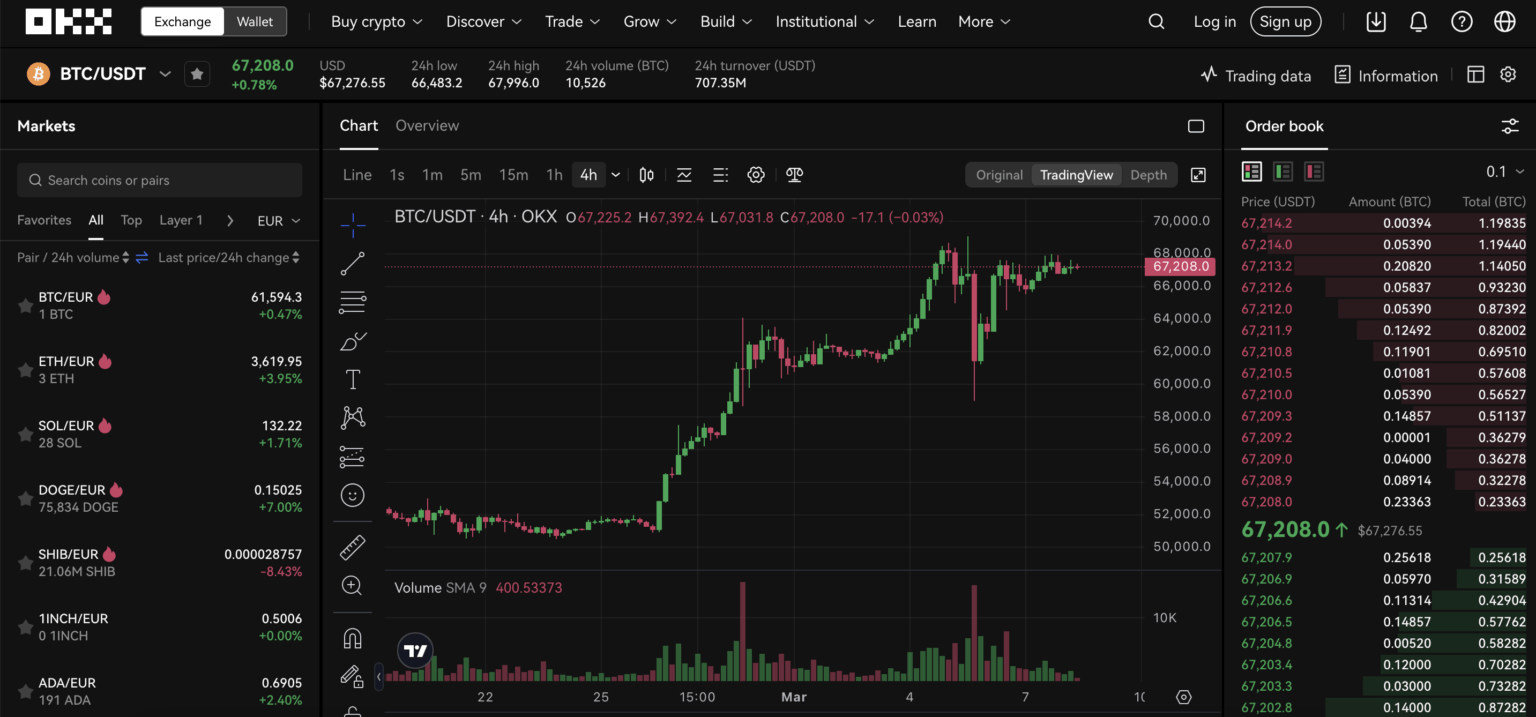
Execution quality matters more than you realize. Liquidity varies by contract. High liquidity pairs like BTC and ETH typically have tight spreads. Smaller altcoin perpetuals can have thin books and abrupt depth changes during news. So watch the order book depth and use iceberg or TWAP strategies on larger fills. It’s tempting to hunt for the best price, but very often time and order type beat impatience.
Leverage, Margin, and Risk Controls
Leverage is a tool, not a goal. Use it to express conviction, not hubris. Position sizing rules still win. If you learned one thing from market history, let it be: keep some dry powder. Risk controls include: pre-defined max drawdown, dynamic position sizing, daily stop-loss checks, and mental rules for trade frequency. These are granular and a bit tedious, yet very very important.
On OKX specifically, margin tiers and liquidation algorithms are clearly documented on their platform. Read those pages. The way margin is calculated—initial vs maintenance—affects when you get liquidated. Also note funding rates: they can cost you over time if you hold trending positions against the crowd. That cumulative cost is often underestimated by first-time perpetuals traders.
Fees, Funding, and the Cost of Holding
Fees are subtle. Maker and taker fees differ. VIP tiers reduce costs but require volume. Funding rates oscillate; they’re not free money. Consider a scenario where you earn maker rebates but pay funding; net cost must be part of your strategy math. Traders who ignore finance costs are leaving edge on the table.
Also, be aware of settlement mechanisms for quarterly contracts versus perpetuals; they can diverge during basis events and lead to funding spikes or unusual spreads. Hedgers and arbitrage desks exploit these gaps fast. If you plan to hold a directional futures position across a major event, hedge the event risk or accept the unpredictability—there’s no neutral middle ground here.
Security, Login, and Account Hygiene
OKX’s security stack includes 2FA, hardware key support, and session management tools—use them. Seriously? Yes. Don’t treat password managers as optional. Enable withdrawal whitelist and regular session audits. If you haven’t practiced account recovery, set that up now; it’s often the part people skip until they need it. (oh, and by the way… save your back-up codes somewhere offline.)
If you’re trying to access your account from a new device or browser, the onboarding flow may require extra verification steps. For straightforward access, most traders bookmark the official okx login page to avoid phishing traps—here’s the link if you need direct access: okx login. Double-check the URL every time you log in; phishing sites are crafty and sometimes convincing.
APIs, Bots, and Automation
Automating strategies demands discipline. Start with small trade sizes. Backtest with realistic fees and simulated slippage. If your bot places dozens of orders per minute, monitoring and circuit breakers are mandatory. Build kill-switches so you can halt trading when outside parameters are breached. Automation without guardrails is like driving fast with no seatbelt—exciting for a bit, then catastrophic.
OKX provides REST and WebSocket APIs. Rate limits exist. Keep an eye on reconnection logic and order state reconciliation. In practice, many bugs arise from race conditions between order acknowledgments and subsequent cancels or replaces. Log aggressively. Your logs will be your friend when something goes sideways at 3 a.m.
Liquidity, Market Structure, and When to Trade
Not all hours are equal. US traders should note that major macro events, US market opens, and big token listings create predictable windows of volatility. Sometimes you want that; sometimes you don’t. Volume is your friend for clean fills. Low-volume windows increase slippage and the chance of stealthy price jumps that take out stops.
Watch funding rate trends and derivative basis to sense where the crowd is leaning. A persistent positive funding rate often indicates longs are paying shorts; that can precede a squeeze. On the flip side, negative funding suggests bearish pressure. Use these signals as context, not gospel.
FAQ
Is OKX available to US residents?
Access and available features vary by law and platform policy. Many traders in the US can create accounts, but certain products or services might be restricted. Always check the platform’s official terms and the local regulatory guidance before depositing funds.
How do funding rates work on OKX futures?
Funding rates are periodic payments exchanged between long and short holders of perpetual contracts to keep the contract price tethered to the spot. When the rate is positive, longs pay shorts; when negative, shorts pay longs. Rates change with market sentiment and can accumulate into a significant holding cost.
Should I use cross margin or isolated margin?
Cross margin shares maintenance across positions and reduces the chance of immediate liquidation but exposes more capital to risk. Isolated margin limits risk to a specific position, which can be safer for discrete trades. Which to use depends on your risk tolerance and strategy design.
What are the basics of staying secure on OKX?
Use strong passwords and a password manager, enable two-factor authentication, use hardware keys if available, enable withdrawal whitelists, keep your devices updated, and avoid logging in on public networks without a VPN. Be suspicious of unsolicited messages requesting credentials or account actions.